

From Roots to Blossoms: Growing Learning Through Nature and Play
The Environment in Which we Learn
"Given a rich environment, learning becomes the air - it's in and around us."
Sandra Dodd
The Environment in Which we Learn
Learning through Indigenous Perspectives and Culture in Relation to the Land:
When you learn through the land you have a responsibility to understand the land, to understand who was there before you, and to respect the land. It is important to have a Land Acknowledgement and to find a respectful way to remind yourself and your group of the gratitude you have for the opportunity to use this land as your learning environment. Land Acknowledgement Going Beyond a Land Acknowledgement
The Land as our Teacher: Exploring Outdoor learning:
Exploring the outdoors is a privilege. There are so many aspects to having the outdoor environment as your learning platform. I don’t believe in discriminating against the use of materials and feel most materials can add value to the learning environment. It is what you do with and how you dispose of materials that should be taken with care. We live in a world of man made materials such as plastic, rubber, metal, paper and of natural resources such as wood, rock, mud, sand and clay. We don’t live in one world of man made or natural materials, they are intertwined within our environment whether we are supporters or not. What is important is to have conversations around these materials. How they got here, how we use them and what our responsibilities are when we have them in our learning environment. I think what is most important is our ability to reflect on our own values and ideas and be the researcher of what you allow into your program.
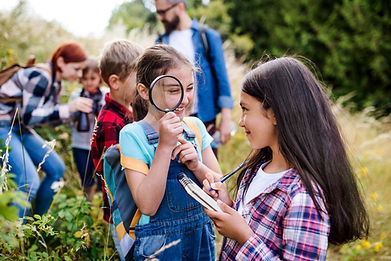
There are many ideas and theories in outdoor learning which sometimes cause educators or parents to view outdoor learning to be difficult. There is no recipe for outdoor learning. The children will lead with their curiosity, they will explore and sometimes they will watch and observe. In an adult's eyes it may seem like they should be doing something, teaching something, however the adult can learn along with the child in the wonder of nature. Stopping to listen to the crunch under your feet, watching an ant carry an object 10 times its size, watching snowflakes fall from the sky, and watching water absorb into the ground are all amazing feats of nature. The educator's job is to observe, look for patterns of play or development and develop ways to support learning. An example is following play schemas. The educator might observe a child with a schema where they need heavy work. They have a need to push hard (sometimes their friends) and lift heavy. With schemas such as this you may want to offer (depending on the child's age, abilities and interests) a push toy like a toy lawnmower, a tire they can roll, a wheel barrel, a large metal shovel, sand, pails to carry sand, logs, rocks. There are no instructions in regards to these materials, they are open ended and are seen as loose parts. It is the child’s desire or interests that will determine what play urge they want to fulfill. This does not mean the educator would not have boundaries in regard to the use of these materials, such as hitting other children or damaging a growing garden, it is important during play to also instill respect for the land and to each other. Play Schemas Loose Parts Loose Parts by Schema Early Years Outdoors
The Voice of the Indoor Environment: Supporting Holistic Learning Through Play
Outdoor learning is ideal but there are factors such as weather, age of children, the space of a program. Indoor learning can have many benefits with a thoughtful design to the indoor environment. No indoor environment should look the same; each environment should support the community of children and families, their location and culture. It should be a place of comfort for the children and the educator.
Outdoor play and indoor play should be through the children's interest and play urges/schemas: An invitation to play is ideal, setting up the environment to invite children to areas of interest that will evoke their curiosity and their wonder. There should be no intention on the adults part in the play, the items and materials should be fluid in the sense that they can be moved from place to place and used in an open ended way. Children will have different interests for example building, trucks and digging. Some children can put those ideas together through the play of construction and building while another child may use dump trucks as a way of transporting materials from one place to another or use the blocks as a way of collecting and sorting. It is the educator who must observe and reflect how the items and materials are used through play to discover the interests and play urges that exist among the children. By reflecting on how the materials are being used will give the educator information on how to build upon the play such as what might not be working, looking further into why it is not working and to see any behavior patterns and analyze if the environment is contributing any behavior factors. What is True Play
The indoor environment has a different sound system than the outdoor environment. Sounds bounce and project louder, there is no natural sound of wind, leaves rustling, birds, traffic flowing, sirens in the distance, a plane overhead or just silence. The air is different, it can be stuffy, a bit more smelly, possibly dry or too humid. Having some soft natural background music and plants in your indoor environment can be helpful. Opening a window to get some fresh air can give a boost if children are seeming tired or out of sorts. Children learn differently indoors; they lose the sense of open space to run and use their body in multiple ways. The indoor space can support this by offering a
way to climb, run, jump and have full body movement. This can be difficult in a smaller area but can be done with the use of items that can be moved, folded or has a place for storage when not in use. Learning Indoors
Holistic learning is a term that is interconnected, it takes into account relationship, mind (meaning intellectual and psychological), emotion, physical and spiritual wholeness. It intertwines with community and where people came from yet keeps people open to other cultural, ethnic and unique ways of being. Holistic Approaches
Relationships to Each Other and to the Environment:
Relationships in the indoor and outdoor environment are the most important factor. The child's relationship with the educator is vital for them to have the freedom to move away and explore both indoors and outdoors. If a child does not feel this sense of relationship they will be hesitant to move into exploration and may want the adult in sight at all times, they may need confirmation that the caregiver is still watching through calling the caregiver over to see or comment on what they are doing. When the child has connection to the caregiver their exploration will expand and independence will take place. When connection and belonging are instilled the children will be able to stand alone in their play as well as with each other as a whole. They will be able to act and celebrate their own ideas and also be able to work with and celebrate the ideas of others. Building Strong Relationships